Agent
CLI overview · Product families · ADR-0049
Anvil Agent connects a smart-glasses client to your own agents. The wearer
talks or types to an agent and reads its reply on the HUD. The agents drive the
glasses back through one MCP tool, memomind_glasses: they can show a card,
run a teleprompter, ask for live captions or a memo, or ask the wearer a
question and wait for the answer. Spoken turns are transcribed through the
Capability Gateway with a route-bound device key. Agent credentials stay in the
service, and it stores no turns.
Command map
| Command | Purpose |
|---|---|
agent validate |
Check agent.toml and its key, login and backend references offline; prints presence only. |
agent run |
Run the loopback Anvil Agent service in the foreground. |
Both read $ANVIL_SERVING_HOME/agent.toml unless --config PATH is given;
the reference file is examples/primary-node/agent.toml.
Client API
| Request | Result |
|---|---|
GET /v1/agents |
{agents: [{id, label}]} for the declared backends, in declaration order. |
POST /v1/agent/turn (multipart agent, plus text or audio) |
{agent, transcript, reply, sessionId, status}. Without agent, the first backend answers. |
POST /v1/hermes/turn |
The v0.1 alias for agent=hermes. |
POST /v1/glasses/notify ({body, title?, kind: notify\|task}) |
Queues a NOTIFY card; returns {id}. |
GET /v1/glasses/events?after=&wait= |
Long-poll (wait capped at 25 s) of {events: [{id, op, ...}]}; expired control ops are left out. |
POST /v1/glasses/answer (multipart askId, plus text, audio or declined=1) |
Settles a waiting ASK; returns {status, transcript}, or 404 once it has expired. |
POST /mcp |
MCP JSON-RPC (initialize, ping, tools/list, tools/call); notifications get 202, GET gets 405. |
OPTIONS on the client paths |
CORS preflight for an allowlisted Origin. |
GET /healthz |
Token-free liveness. |
A turn that cannot be transcribed returns 502, and silence returns 422. A
backend that answers with an error status returns 502 naming only that status;
its body is never forwarded or logged. A backend that does not finish within
turn_timeout_seconds returns 504 with unconfirmed: true, because the agent
may still finish in its own session.
These limits bound memory and threads:
- As in Scribe,
max_recording_seconds(300 by default) refuses longer recordings while decoding.max_concurrent_transcriptions(2 by default) caps decodes in flight, and a spoken turn that finds no free slot within 30 seconds returns 503. - At most eight request bodies are held at once, because an agent turn or
ASKkeeps its body until it finishes. A ninth concurrentPOSTgets 503 before its body is read. Answers toASKhave two slots of their own, so waiting questions cannot lock out their answers. - A body must arrive within 60 seconds, and a socket that goes quiet for 30 seconds is dropped. Forms go through Scribe's flat parser: parts are read one at a time and never recursively, and a form with more than 16 parts, a part header over 8 KiB, or a transfer encoding gets 400.
/mcpand notify bodies are JSON of at most 64 KiB; only turns and answers carry audio up tomax_upload_bytes. An MCP batch of more than 16 messages is refused whole with one-32600error.- As in Scribe, the server holds at most 16 connections and drops further ones.
The memomind_glasses tool
| Op | What happens | Microphone |
|---|---|---|
NOTIFY |
A card on the HUD, style notify or task. |
no |
TP |
v=1 shows content as teleprompter pages; v=0 closes it. |
no |
LS |
Live captions on (v=1) or off (v=0). |
after a press |
RC |
Record a memo on or off, with an optional Scribe profile as mode. |
after a press |
MR |
Meeting minutes: RC with mode minutes. |
after a press |
ASK |
Shows a question and waits up to timeoutMs (5–120 s) for the wearer's answer, declined or timeout. One question waits at a time; another gets busy. |
after a press |
STATUS |
Reports whether the glasses app is open. | no |
Microphone ops only show a request card: nothing records until the wearer
presses the glasses button, and stop requests apply at once. Control ops expire
60 s after they are queued, so a command sent while the phone was locked cannot
start anything later. NOTIFY cards stay in a ring of the last 50 events. Every
result says whether the glasses app is open; ASK returns not_open at once
instead of waiting for nobody. The queue lives in memory, and a restart drops
it.
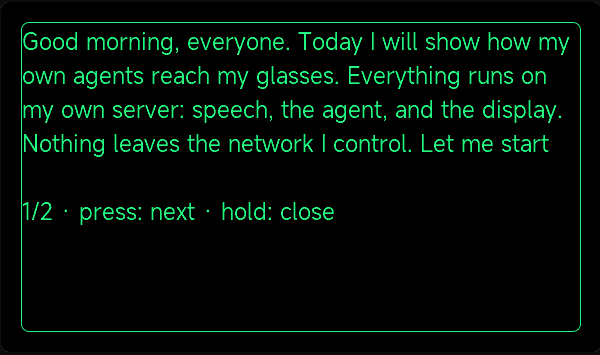
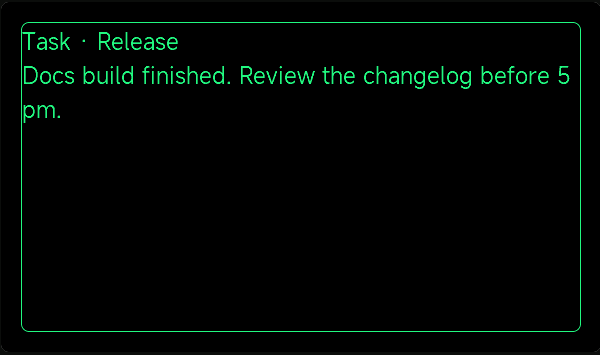
A TP teleprompter page and a NOTIFY task card on the 600x350 glasses
display, as shown in the Plugin Studio simulator:
Register the tool with an MCP-capable agent by its URL. A Hermes example:
Backends
Each [agent.backends.<id>] declares one agent. The id is what clients send as
agent, and the backend whose id is hermes also answers /v1/hermes/turn.
kind |
Turn API | session |
|---|---|---|
hermes-api |
The Hermes API server's POST /v1/chat/completions, with X-Hermes-Session-Id; no model override, so the profile's own model answers. |
The API-server session that keeps the glasses history (default anvil-agent). |
pi-web |
pi-web's mobile bridge: prompt the session, wait until it stops streaming, then read the newest assistant message. | Required: an existing pi-web session id. The bridge cannot create sessions. |
The HUD hint (at most two short plain sentences) is sent as a system message to Hermes and prefixed to the text for Pi, which has no system channel. Backend requests use no proxy discovery and follow no redirects, so a credential reaches only the declared URL.
Access
The device key is either the protected file written by router keys create
--out (router_key_file) or an environment reference (router_key_env). The
reference config uses agent.key beside agent.toml: a relative path is read
beside the config, and the Compose file mounts that key next to it. Each
backend credential is likewise key_file or key_env, and the login allowlist
is an environment reference. As in Scribe, environment references read the
process environment and then the operator .env, so agent validate on the
host sees the same values as Compose. The service refuses to start when any of
them is empty, or when listen_host is not an IPv4 loopback address. Only requests whose
Tailscale-User-Login header names an allowlisted login are accepted, and a
browser Origin, when sent, must match allowed_origin_pattern. Publish the
listener through tailscale serve and nothing else.
A page on an allowed origin could send a cross-origin POST that skips the
CORS preflight. So /mcp refuses any request that carries an Origin (MCP
clients are agents, not browsers), and notify from a browser must be
application/json, which always preflights. CORS headers are sent only on the
client paths.
One service serves one person. Every allowlisted login shares the event queue,
the waiting ASK and each backend's session, so list only your own logins.
Run a second service, with its own port, sessions and tailnet listener, for anyone
else.
Issue a key bound to the STT route and the transcription path only:
anvil-serving router keys create --name agent --model STT_ROUTE_ID --path /v1/audio/transcriptions --rpm 120 --out ~/.anvil-serving/agent.key
Deploy
Build the agent image target, which shares the Scribe stage's ffmpeg layer,
then manage the container through the generic serve lifecycle:
docker build --target agent -t anvil-serving-agent:3.1.0 .
anvil-serving agent validate
anvil-serving serves up agent --manifest serves.agent.toml --dry-run
anvil-serving serves up agent --manifest serves.agent.toml --confirm
Anvil Agent and Anvil Scribe can share one tailnet origin: mount /v1/memos on
Scribe and the paths above on Anvil Agent.
Privacy
The service stores no turns, answers, captions or questions. Logs record method, path, status, byte counts, latency and allow decisions, never audio, transcripts, replies or identity values. Glasses audio and transcripts are user content, never evidence: do not use them to train, fine-tune or evaluate a model.