AZ-Focus and Mia GLM-5.3-Flash derivatives: matched fixed-set result
- Model
- mia-glm-exl3-tp2 and az-focus-exl3-tp2
- Engine
- TensorFold engine revision f350cd3ea253a042e205746928271f9d8f71a82d
- Quantization
- EXL3; distinct model snapshots
- Hardware
- RTX PRO 6000
- Context tokens
- 7680
- Concurrency
- 1, 4
- Retained artifacts
- 10 capacity · 0 quality suites
Main limitation: No statistically supported 60-case accuracy difference: three paired gains and three losses, McNemar two-sided p=1.0. · Retained evidence
Date: 2026-11-21
Status: completed focused local measurement; no-promotion; restored serving with the pre-existing monitoring-registration gap retained.
Result card
On the fixed local 60-case subset, AZ327-Focus and Mia tied at 49/60; AZ327 used less summed sequential C1 request time, without establishing an accuracy, throughput, capacity, or promotion result.
| Setup | Qualified value |
|---|---|
| Model | Mia EXL3 TP2 and AZ327-Focus EXL3 TP2; distinct snapshots |
| Hardware | Two RTX PRO 6000 Blackwell Max-Q GPUs, TP2 |
| Contract | 60 fixed text/reasoning cases, 16,384-token cap, sequential C1 |
| Measurement | Sum of individual request times, not outer wall-clock |
| Decision | no-promotion; no default, route, or deployment change |
| Headline measurement | Local result | Conditions |
|---|---|---|
| Complete correct | 49/60 each | literal publisher parser |
| Summed sequential C1 request time | 215.195 s AZ vs 487.233 s Mia | 55.83% less for AZ |
| Important boundary | no broad speed conclusion | matched C4 cells are distinct n=8 observations |
Important caveat: coverage is partial: the paired SWE result is only five official images, broad capacity/concurrency remains unmeasured, and the pre-existing monitoring-registration gap is retained. See the evidence index, artifact ledger, and publication summary.
Decision
On one fixed 60-case text/reasoning set, the final AZ327-Focus EXL3 profile and the Mia EXL3 profile achieved the same publisher-parser score: 49/60 complete correct responses (25/30 MMLU-Pro and 24/30 BBH). AZ327-Focus completed that sum of sequential C1 request times of 215.195 seconds versus 487.233 seconds for Mia: 2.26× as fast by this summed-request measure, or 55.8% less summed request time. This is matched local per-request timing evidence, not an accuracy improvement, general throughput claim, capacity result, or promotion recommendation.
The campaign also retained a separate one-card Qwen FP4 compatibility lane. It received all eight responses but none was performance-eligible because the opening canary failed in every case; it supplies neither a timing nor a quality comparison.
Matched GLM measurement
Both profiles used the same 60 inputs, request controls, external literal publisher parser, and 16,384-token local output cap. The paired corpus and parser hashes are retained in the raw extracts. The reported total is the sum of individual sequential C1 request times, not an outer-process wall-clock duration, token throughput, or time to solve a shared interactive task.
| Profile | Complete correct | Length-limited | Sum of C1 request times | Completion tokens |
|---|---|---|---|---|
| Mia EXL3 TensorFold | 49/60 | 1 | 487.233 s | 86,651 |
| AZ327-Focus EXL3 TensorFold | 49/60 | 0 | 215.195 s | 36,662 |
The profiles were jointly correct on 46 cases. Each had three cases the other missed; the exact two-sided McNemar result is 1.0. For jointly correct cases, the median request wall latency was 1.297 s for Mia and 0.970 s for AZ327-Focus. AZ327 had lower request time on 35/60 requests; its median paired per-request speed ratio was 1.09118×. These per-request figures are distinct from the summed-request-time ratio. All 60 visible answers are byte-identical to the earlier AZ64 run, but all 60 request and raw-event digests differ; the final result is a real reexecution, not a reused trace. The per-case digest receipt retains the public-safe hash proof without prompts or answers. These facts do not establish an accuracy uplift.
The public evidence describes dual RTX PRO 6000 Blackwell Max-Q TP2 local measurement. AZ327 used the same 327,680 configured context, runtime image, and invocation flags as Mia except for name/port and offline-download settings; the model snapshots remain distinct. It passed a standard approximately-128K retrieval check and a 20/20 shared-prefix tool batch. Those are bounded functional checks, not a context or broad tools qualification.
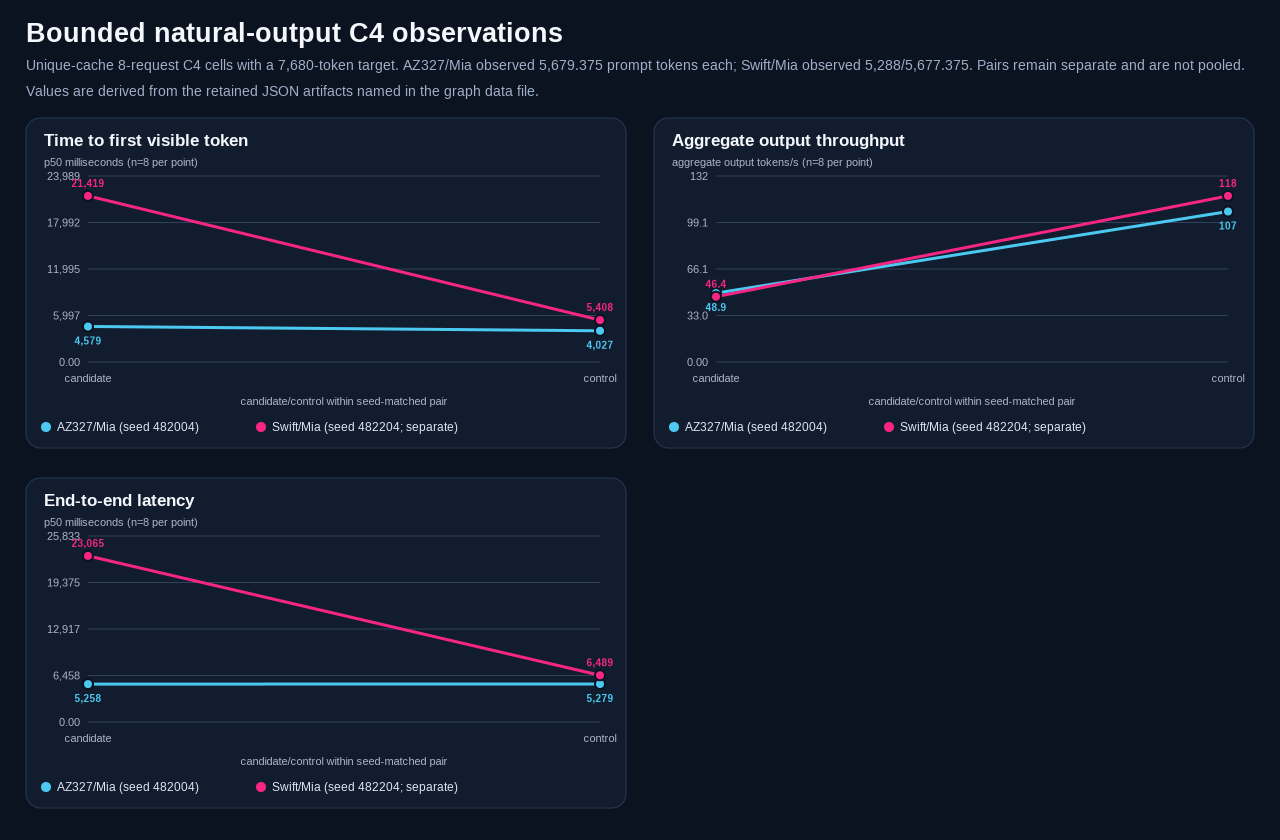
The matched 327K/C4 summary does not show a broad concurrent speed win: AZ327 first-visible latency was 4.579 s versus Mia's 4.027 s, median end-to-end latency was 5.258 s versus 5.279 s, and aggregate output was 48.93 versus 106.94 tok/s with 86.5 versus 191.38 output tokens per request. The machine-readable AZ327 C4 receipt and Mia C4 receipt retain the eligible eight-request populations. The serial 60-case result therefore does not support a broad concurrent-speed claim.
The matched-C4 observation matrix and its numeric data show the AZ327/Mia and Swift/Mia pairs separately; they are not pooled.
Paired SWE-Bench Verified five-image scout
Both arms completed the same five independently checked official images, with the same selection, profile hash, request controls, agent/grader revisions, container limits, prompt contract, and network policy. AZ resolved 4/5 in 740.844 s of agent time; Mia resolved 3/5 in 1668.975 s. Both resolved SymPy and xarray; AZ alone resolved Sphinx and pylint; Mia alone resolved Django. Official grading took roughly two minutes per arm. This is a five-image scout, not a full SWE-Bench score or a promotion recommendation.
See the paired per-case projection and native-score provenance.
AZ327 capability scout
AZ327 resolved both bounded Aider tasks (Affine and Go) on their first attempts, passed all 12 context checks across 8K and 32K, and passed its 3/3 native agentic task set (structured-edit rev8, tool-sequence rev8, debug-loop-v2 rev9). The matched Mia controls used the same OCI oracle: Mia passed Affine first attempt and Go second attempt, while AZ passed both first attempt. Two earlier missing-oracle failures occurred before inference; the recovery used a verified same-day cache and the matched oracle image. This remains a scoped capability comparison, not a broad quality conclusion.
Swift light scout
The Swift light profile exercised four actual 24,576-token slots, a configured vision projector, and a two-GPU layer split. Its 2,048-cap oracle arm passed 3/3 semantic and 3/3 exact checks; the Mia arm passed 3/3 semantic and 2/3 exact. The vision observation was console-only and length-stopped, without a raw image receipt; it establishes configuration, not accepted visual accuracy. The clean C4 seed-482204 run was 8/8 eligible with 0.17% cache hit, 21.419 s first-visible, 23.065 s end-to-end, and 46.377 tok/s aggregate output. The matched Mia cohort was also 8/8 clean (0 cache hit, 5.408 s TTFT, 6.489 s end-to-end, 118.029 tok/s). This is a matched C4 result, not a general capacity or deployment conclusion. The initial C1, n=3, temperature-1 timing population is not comparable to Mia; The matched natural C4 cohort is retained above. This is a narrow scout, not a speed, capacity, or replacement result.
See the capability-scout aggregate.
Tev compact scout
The compact 146.01-GiB Tev community release loaded as a two-card layer split with four 24,576-token text-only slots. It passed smoke, JSON, and 20/20 tools, plus 3/3 native agentic tasks (structured-edit rev8, tool-sequence rev8, dependent-result rev8) and Go alphametics 1/1 on its second attempt. Its oracle image matched the earlier Mia 0/1 image on one historical case; that is not a comparative control. No visual, speed, capacity, or replacement claim follows.
Separate compatibility lanes
The one-card Qwen FP4 lane is a bounded functional receipt only: 8/8 responses arrived, but all 8 failed its opening-position validation, so the eligible population is 0/8. The AZ64 native template's image path is a separate failed profile: it substituted image parts with text and produced 12/12 pre-generation HTTP 500 outcomes. The final AZ327 profile instead used Mia's exact image-built template and passed all 12/12 image cases. This establishes only that bounded image-case result, not broad vision qualification.
QAD R2 repeated the C4 boundary: all eight responses had exactly one nonleading marker and zero foreign markers at client concurrency four, leaving 0/8 performance-eligible. R3 then passed bounded multimodal 12/12 and native agentic 3/3 (structured-edit rev8, tool-sequence rev8, dependent-result rev8) on one NVIDIA GPU. Its NVIDIA recipe uses a patched vLLM build, FP8 KV, configured 262,144 tokens, and about 26.82 GiB host embedding-table offload; it is not a GPU-only fit or a tested full-window result. No timing canary rerun or performance result is claimed. The pinned NVIDIA model and recipe source is retained in the configuration reconstruction.
The final one-card QAD 12-item publisher pilot scored 10/12, alongside AZ327
10/12 and Mia 9/12 on identical items. Its summed request time was 183.073 s
and 35,865 completion tokens, versus AZ327 39.97 s and Mia 57.36 s. QAD uses
xhigh while GLM uses max, with different engines and GPU counts; this is a
partial cross-runtime pilot, not a broad speed or quality ranking.
Comparability limits
This local pair uses a 16,384-token cap and a top-level reasoning-effort control. The publisher's external demonstration used a 32,768-token cap and a different template-control surface. Therefore, this finding compares the two local profiles with each other; it is not a direct reproduction of an external published score or speed result.
Managed candidate trial loads and unloads occurred during this campaign. No promotion, default, or route change is claimed. A verified Mia restoration checkpoint returned authenticated primary-alias HTTP 200/READY at 327,680 configured context and direct running status. The monitoring-registration gap predates this campaign; restored serving remains working, but that gap is retained and no promotion is authorized. See the restoration record.